Hallucination Reduction in Research Agent Outputs
Grounding agents in live data, not model weights, cuts hallucination.

Hallucination in research agent outputs gets called a model problem. It's not. It's a data freshness problem wearing a lab coat, and the fix is infrastructure, not smarter models: ground the thing in live, verified information at the moment it answers, instead of trusting whatever froze into its weights months ago. Everything below argues for that one claim, and only that one.
The scale of the problem in production, and why it is worse for agents than for chatbots
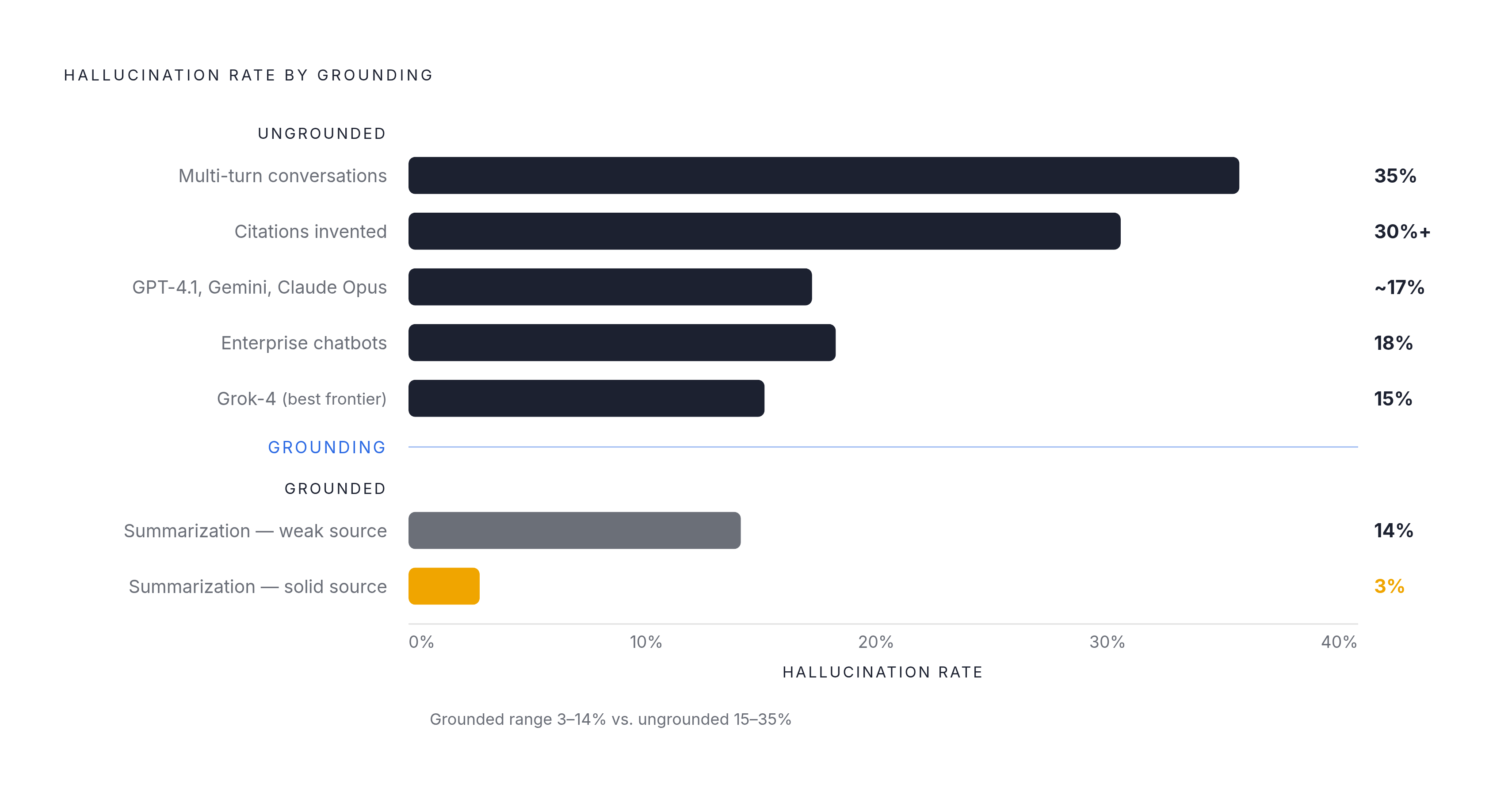
Start with the raw numbers. Without grounding, factual queries come back wrong 15% to 25% of the time. That's one in five, maybe one in six, answers wrong enough to cause a real problem. Enterprise chatbots running live report hallucination rates around 18%. Citations get invented in over 30% of research-style chatbot answers, and multi-turn conversations, where the model has to keep its story straight across several exchanges, climb as high as 35%.
Agents don't just talk. They act, and that's the part that should worry anyone building agents instead of chatbots. A chatbot that hallucinates says something embarrassing. An agent that hallucinates opens a support ticket based on a false premise, updates a record, sends the email, kicks off the workflow, all before a human gets a chance to squint at it. The wrong assumption doesn't sit there waiting to be caught. It becomes an input into the next step, and then the step after that.
These failures are quiet ones, too. An agent that answers fast and sounds confident looks like it's working, right up until someone checks its homework. Analysis of agent deployments has found hallucination to be the single biggest reason people abandon these tools, and once error rates cross 30% in a high-visibility rollout, users don't wait around for the next version to fix it. They leave, and they don't say why in the exit survey.
The airline case makes the stakes concrete. A chatbot invented a bereavement refund policy that never existed, and the company had to honor it anyway, because the customer had been told it was real. Now stretch that same failure mode to an agent autonomously approving discounts or drafting compliance reports. The exposure gets a lot bigger than one refund, fast.
Even the best models available don't clear this bar alone, and no amount of model shopping changes that. A benchmark from mid-2026 (Artificial Analysis, AA-Omniscience) put the top-performing frontier model, grok-4, at a 15% hallucination rate. Other leading models, including gpt-4.1, gemini-3-pro-preview, and claude-opus-4.1, landed around 17%. That's the ceiling right now. Architecture moves that number. Model selection doesn't.
Why the knowledge cutoff is the most actionable failure point
A model's training is a snapshot frozen on a specific date. Everything after that date doesn't exist to it, and neither does anything too obscure or specific to have made it into the training data in the first place, which is a separate problem hiding inside the same one.
That gap widens every day the model sits in production. Leadership changes. Funding rounds close. Regulations get amended. Prices move, stock runs out, and the model has no idea any of it happened. Ask about a product that launched after its cutoff and it does one of two things: admits it doesn't know, which is the honest outcome, or generates something plausible-sounding based on similar products it does remember. That second outcome is the dangerous one, because it reads exactly like a fact. It's built out of the same material facts are built out of.
There's a quieter version of the same problem, and it doesn't get talked about enough: the long-tail gap. Training data skews hard toward whatever gets discussed most, so niche industries, specialized technical fields, and anything published recently are all underrepresented relative to how often people actually ask about them. Scaling the model up doesn't fix this. A bigger model reasons better over what it knows, but it doesn't know more about what was never in the data to begin with. The holes are structural, not a matter of horsepower, and no number of extra parameters patches a hole that was never filled in the first place.
The fix here is specific, and honestly almost boring: don't ask the model to remember the fact. Ask it to go look the fact up, right now, from a live source. That single move is what separates a stale-data hallucination (a freshness failure) from a confabulation (the model inventing detail to fill a gap it can't otherwise fill). Different diseases. Different medicine.
Static RAG reduces hallucination but introduces its own failure modes
Retrieval-augmented generation is the standard answer: feed the model current, retrieved text so its answer rests on something citable instead of something memorized. Static RAG does this by pulling from a vector database of documents indexed ahead of time, and for stable material, internal policy documents, product manuals, anything that doesn't change week to week, it holds up fine.
It hits three structural walls anyway. Content goes stale between indexing runs. Retrieval is bounded by whatever got ingested, so the agent is blind to anything that never made it into the database. And somebody has to maintain that corpus indefinitely, which is a job, not a one-time setup you walk away from and forget.
RAG also carries failure modes that have nothing to do with freshness, and this is where teams get overconfident. A 2026 study on RAG hallucination found retrieval can surface information that's outdated, irrelevant, or simply unverifiable, and the model has no built-in way to tell the difference. Even when retrieval hands the model the exact right document, the model can still summarize it wrong. That's not a factuality problem anymore, it's a faithfulness problem: the source was correct, the model's reading of it wasn't. Fixing one doesn't fix the other, which is why engineers constrain the model to answer strictly from retrieved text, keep the context tight, and add a verification step for anything high-stakes.
Confidence scores don't help either, and it's worth being blunt about why: a model's confidence reflects how fluent the sentence sounds, not how well-supported the claim is. Research finds prompt-based mitigation cuts hallucinations by about 22 percentage points. Real progress, but it does nothing if the retrieved context was stale to begin with. Summarization tasks grounded in genuinely good source text hit hallucination rates as low as 3% to 14%, depending on model and benchmark, and that range is the target. It's what's achievable when the retrieval underneath the model is solid. Everything above that range is a retrieval problem, not a model problem, and treating it as the latter is how teams end up swapping models for a year instead of fixing the pipeline.
Live web retrieval as the grounding mechanism that static corpora cannot replicate
Live web RAG skips the pre-built database and queries real-time search at the moment the question gets asked, pulling from the open web with no indexing lag and no artificial ceiling on scope.
It handles both hallucination types at once, and static RAG simply can't make that claim. Stale-data hallucinations happen because the model's internal snapshot is out of date, and live retrieval replaces that snapshot with today's version of the page. Confabulation happens because the model fills a gap with a plausible guess, and live retrieval hands it the actual fact instead. No gap, nothing to fill.
The measured gains back this up. Web-grounded systems show accuracy improvements of 25 to 40 percentage points on benchmarks like SimpleQA and FRAMES compared to ungrounded baselines, according to research published by Firecrawl. Research into hybrid RAG architectures found consistent error reductions of 35% to 60%.
None of it works, though, if the retrieval feeding the model is sloppy. Search that actually matches the intent behind the question, returning excerpts pre-filtered to what's being asked, keeps junk out of the context window. Clean, dense output, Markdown instead of raw HTML, keeps the input token-efficient and readable. Freshness controls matter more than they sound like they should, too, because "live" retrieval that's secretly serving a cached copy from three days ago is stale data mislabeled. It's static RAG wearing a costume, and a cheap one at that.
The clearest real-world case comes from the Stanford AI Playground, which grounds LLM responses for the Stanford community using Firecrawl's Search and Scrape endpoints. It pulls from roughly 800 real-time sources a day, spread across more than 10,000 domains, covering scholarship databases, news outlets, government sites, and academic repositories. Coverage went from 293 URLs in September 2025 to over 13,000 by February 2026, a 46-times increase in six months. Search latency averages around 1.5 seconds, scrape latency around 2.6 seconds, both workable for research use. Before live retrieval, answers were locked to whatever the training cutoff allowed. The before-and-after is the whole argument, shrunk down to one case study.
Live retrieval isn't free, to be fair. It costs more in latency than a vector lookup, and it costs money per call. For a research agent where the entire value proposition is being current, that trade is worth making every time. No exceptions, no asterisks.
Why live web access became technically harder to achieve in 2026
Right as agents started needing the open web the most, the open web started closing the door on them. Nobody planned this collision, but it's the one that matters most right now.
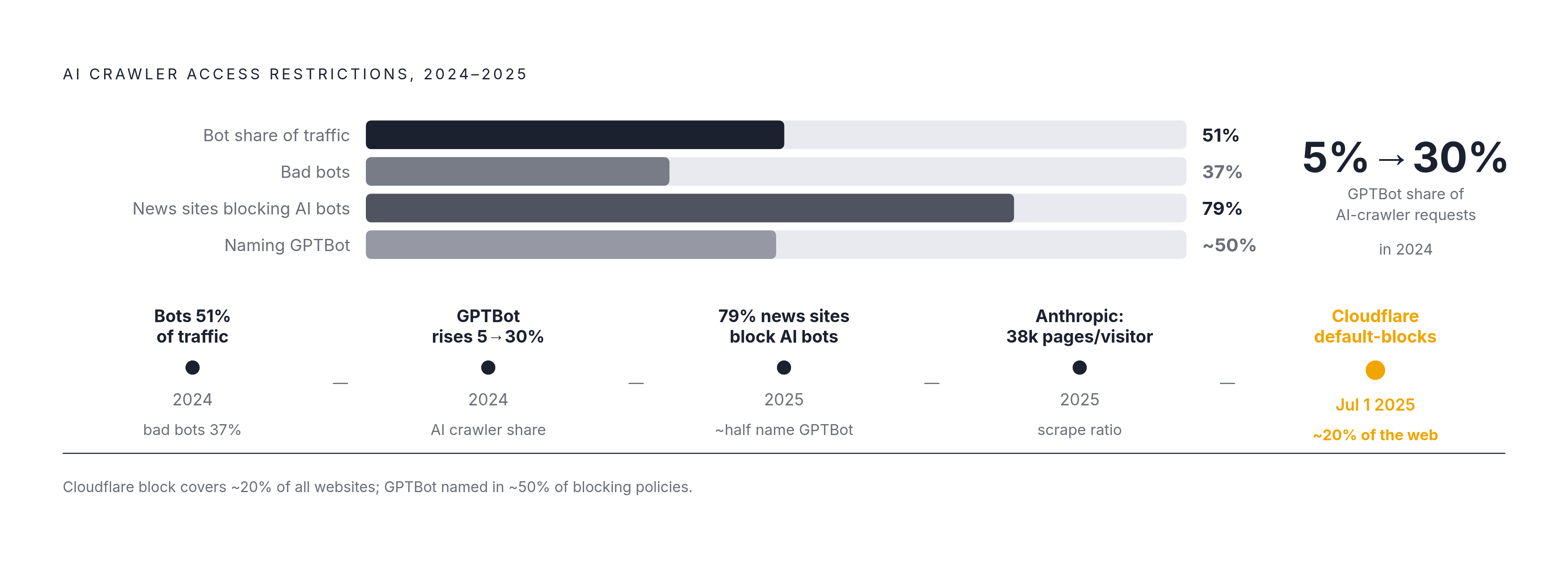
In 2024, automated bots made up 51% of all web traffic, the first time bots outnumbered humans in a decade, and bad bots alone accounted for 37% of it, according to Imperva's 2025 Bad Bot Report. Cloudflare's data shows GPTBot's slice of AI-crawler requests jumped from 5% to 30% in a single year.
Then came the policy shift. On July 1, 2025, Cloudflare flipped blocking AI crawlers to the default setting for its customers, a change covering roughly a fifth of the entire web, and making AI crawler blocking the default for its customers. Cloudflare also launched a pay-per-crawl marketplace in private beta around the same time. By 2025, about 79% of major news sites were blocking AI training bots outright, and close to half of them named GPTBot specifically in their block lists.
The economics explain the panic. Cloudflare found that Anthropic's crawler was pulling around 38,000 pages for every single visitor it referred back to the source site. From the publisher's side, that's not a partnership, that's a tollbooth with no toll. Sites aren't blocking access on principle. They're blocking extraction at that kind of ratio, and the ratio is the whole explanation, no principle required.
The defenses have gotten sharper too. Modern anti-bot systems stack IP reputation, TLS fingerprinting, browser-behavior analysis, and request-rate patterns, all running at once, and a request coming from a plain cloud datacenter IP gets flagged fast, often within the first few calls. The access layer, the actual plumbing of getting a real page to load like a real browser loaded it, has become the deciding factor between an agent that works and an agent that gets handed a 403.
The timing is almost comically bad. Gartner expects 40% of enterprise applications to ship task-specific AI agents by the end of 2026, up from under 5% in 2025. Demand for open-web access is exploding at exactly the moment the web is pulling up the drawbridge.
The engineering layers a research agent pipeline needs to retrieve reliably
Hallucinations are baked into how these models work. Nobody eliminates them outright, so stop waiting for a silver bullet that isn't coming. The realistic goal is containment: catch the bad output, constrain what the model is allowed to say, correct it, and do all three before it reaches a user or fires off some downstream action.
That containment starts lower in the stack than most teams expect, and this is exactly where most builders skip ahead to the part they find interesting.
Layer 1 is just getting the page to load correctly, and it's the layer most engineers underestimate until it breaks everything sitting above it. JavaScript has to actually run. Anti-bot defenses have to be navigated, not fought head-on. The response coming back needs to match what a real person would see in a real browser, not some stripped-down shadow of it. When this layer fails quietly, every layer above it reports the wrong problem: the parser throws an error because the HTML is malformed, the agent decides to replan because the page came back empty, the model hallucinates because it got handed garbage and asked to make sense of it anyway. Getting this right takes residential or mobile proxies with control over country and network, browser fingerprinting that holds up across TLS and HTTP/2 and headers, JavaScript rendering for pages built dynamically, and bypass capability for defenses like Cloudflare, DataDome, PerimeterX, Akamai, and Kasada, plus retry logic with proper backoff.
Layer 2 is turning that page into something clean. Raw HTML is not something a language model should ever have to reason over directly. All those tags and scripts and navigation menus are noise that pushes the model back toward guessing from training data, which is the exact failure this whole pipeline exists to engineer away. Clean Markdown, or structured JSON where it fits, keeps the context tight and the tokens efficient. Handling search, scraping, and cleanup through one unified call closes off a quiet failure mode too: integration seams where grounding breaks silently and nobody notices until the output starts looking a little off.
Layer 3 is picking the right retrieval strategy for the content in front of you. Static RAG still makes sense for stable material, internal documentation, policy text, anything that isn't going to change by next Tuesday. Live web search is for anything current, anything on the open web, anything where freshness is the whole point of asking in the first place. Latency-optimized search modes can return results in the low hundreds of milliseconds, which matters once an agent starts chaining several retrieval calls together in a single research task. Get this layering right, and "grounded" stops being a word on a slide. It starts being something that actually holds up when the agent is out there working, unsupervised, on someone else's deadline.